ABRASIVE BLASTING
In short
Dion Peinture industrielle uses abrasive blasting to strip rust, mill scale and old coatings, then leave a rough surface the paint can grip. It works on steel, concrete and sometimes aluminum, at the 6,000 sq ft shop in Rouyn-Noranda or on site across Abitibi-Témiscamingue, Nord-du-Québec, northeastern Ontario and Nunavut.
- Dry or wet abrasive blasting
- Abrasives: sand, glass or baking soda
- SSPC/NACE grades, from white metal (SP 5) to brush-off (SP 7)
- Concrete profiles CSP 1 to 10, per ICRI guides
- 6,000 sq ft shop or on site

dry abrasive blasting
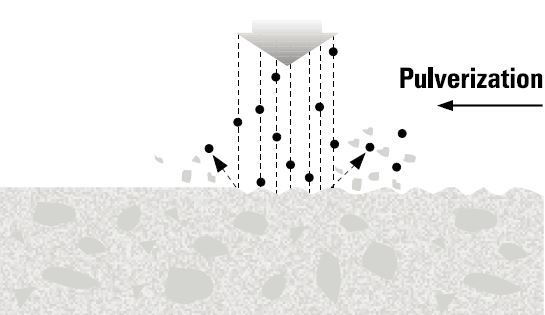
The most commonly used surface preparation method for applying coatings is high-pressure abrasive blasting. The basic principle is to remove rust, mill scale or other surface contaminants and to obtain a suitably rough surface for the adhesion of a future coating. This is done by projecting a highly concentrated stream of abrasive particles at high velocity against the surface to be cleaned. The velocity of the abrasive particles erodes the surface. Indeed, when modern coatings are applied, there is no truly satisfactory or economically equivalent replacement process, except for horizontal concrete surfaces. This method is generally used on steel, concrete and sometimes aluminum.
The standards below correspond to the degree of surface preparation of steel by dry abrasive blasting that are mainly used in the industry:
SP 5/NACE No. 1 White metal | Removal of all traces of visible rust, mill scale, paint and foreign matter by abrasive blasting (dry or wet) using sand, corn, glass, etc. For severe service conditions where the high cost of cleaning is justified. |
SP 10/NACE No. 2 - Near-white metal | Near-white metal, until at least 95% of the surface is free of all visible residues, with staining permitted on the remainder. For high humidity, chemical atmosphere, marine or other corrosive environments. |
SP 6/NACE No. 3 - Nettoyage commercial | Blasting until at least two thirds of the surface is free of all visible residues, with staining permitted on the remainder. For conditions where a thoroughly cleaned surface is required. |
SP 7/NACE No. 4 - Brush-off blast | Blasting of all surfaces, except tightly adhering mill scale, rust and coating residues, while making the surface uniformly rough. |
WET ABRASIVE BLAST
The principle is basically the same as the dry method, but a small percentage of water is added to the dry particles. Adjusting the water supply lets us increase or decrease the percentage of dust generated by the particles shattering on the substrate. Several types of equipment exist to carry out this process. The advantage of wet abrasive blasting is that dust is greatly reduced, which lets us carry out projects without a sealed containment and, at the same time, eliminates the use of a dust collector.
The corresponding standards for wet abrasive blasting are as follows:
- NACE WAB-1/SSPC-SP 5 (WAB) - White metal wet abrasive blast cleaning
- NACE WAB-3/SSPC-SP 6 (WAB) - Nettoyage humide commercial
- NACE WAB-8/SSPC-SP 14 (WAB) - Nettoyage humide industriel
- NACE WAB-4/SSPC-SP 7 (WAB) - Brush-off wet abrasive blast cleaning
FOR CONCRETE, THE VARIOUS TECHNICAL GUIDES PREPARED BY THE ICRI (INTERNATIONAL CONCRETE REPAIR INSTITUTE) ARE USED. DEPENDING ON THE APPLICATION, A CSP PROFILE FROM 1 TO 10 IS DETERMINED.
Abrasives
The media we use for abrasive blasting:

Dion Peinture Industrielle has all the expertise needed to carry out your work, from small to large scale. We can do the work at our shop or on site.
We are THE SPECIALISTS in abrasive blasting in the region!
Frequently asked questions
What is the difference between dry and wet abrasive blasting?
Wet blasting adds a small amount of water to the abrasive. That cuts the dust a lot, so many jobs can be done without a sealed containment or a dust collector. Wet blasting has its own SSPC/NACE WAB grades.
Which preparation grade does my steel need?
It depends on the service conditions. White metal (SP 5/NACE No. 1) is for severe service. Near-white metal (SP 10/NACE No. 2) suits high humidity, chemical, marine or other corrosive settings. Commercial (SP 6) and brush-off (SP 7) cover lighter needs.
Do you blast at your shop or on site?
Both. Parts that can be moved go to the 6,000 sq ft shop in Rouyn-Noranda. For the rest, the crew comes to you. Call 819 762-6005 or request a quote online.
· Reviewed by Marc-André Vaillant, P.Eng., Director, NACE Certified Coating Inspector Level 3